
 V-beltls
  Cogged Belts
  Timing Belts
  Hexagoanal Belts
  Ribbed polly V-belts
  Agriculture Belts
  Conical Belts
  Conveyor Belts
  Gear Boxes
  Pulley & Coupling
  Rubber Sheets
  Steel & Power Plants
  Rice/Floor mills
  Cement
  Paper Mill
  Agricultural
  Harvester Combine
  Ceramic
  Food Processing
  Textile
  Oil and Gas
  Pharmaceutical
  -Collapsible-Belt Length Measure
 -Belt Drive Service Kit
 -Digital Tension Meter
 -X'Align Lasertool
 -Belt Length Measure
 -Analog Tension Tester
 -Belt Profile Gauge
 -Pulley Gauges
 -Pulley Guage Banded Belts
 -Pentagon Poly-V Belts Wear Gauge
 -Pentagon Timing Belt Wear Gauges
 -X'Slit Belt Cutting Machine
V-beltls
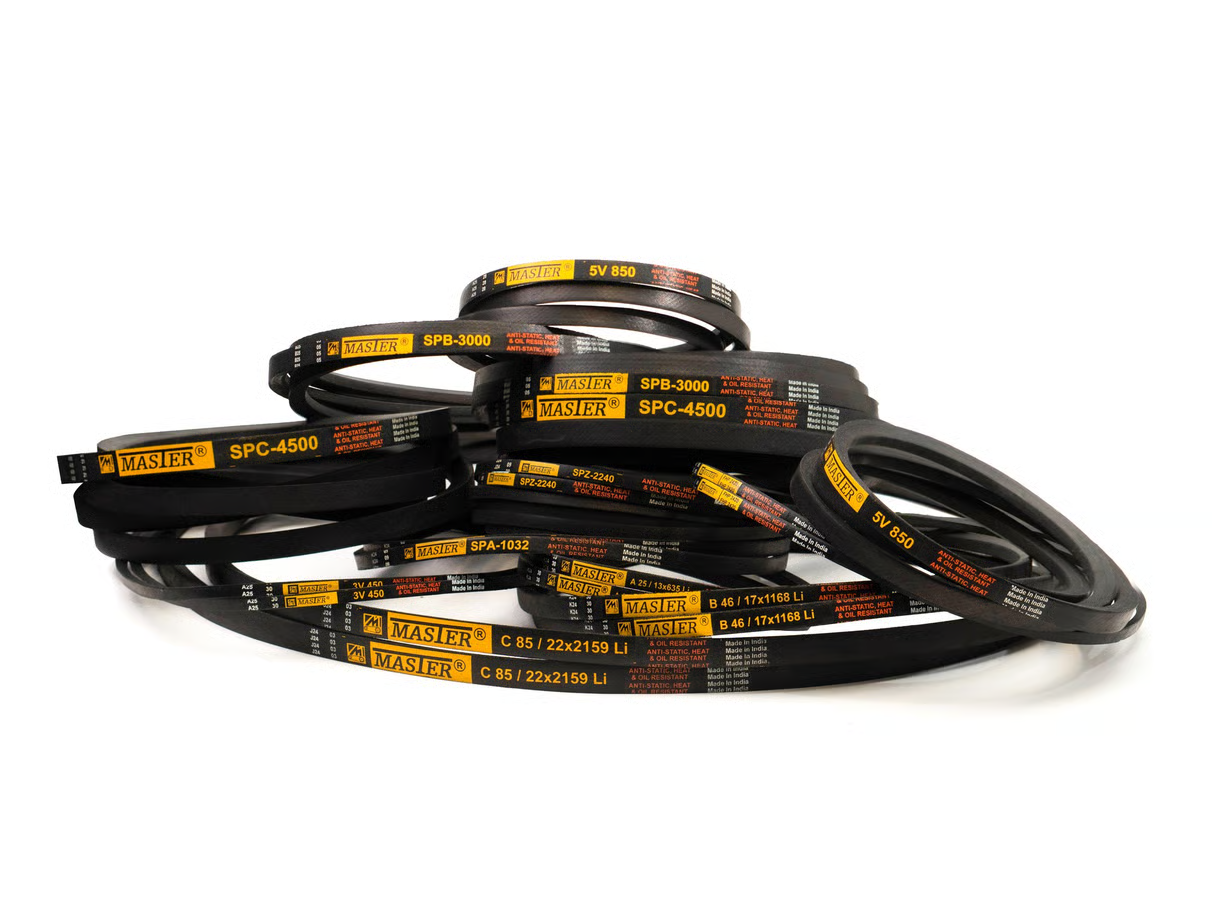
A V-belt is a highly effective and versatile component designed for power transmission between shafts. Its trapezoidal shape allows it to fit securely within the grooves of a sheave, maximizing surface contact and ensuring superior stability.
When tension is applied, vertical forces push the belt’s sides against the sheave grooves, creating a strong wedging effect. This increased friction enhances grip, improves torque transmission, and minimizes power loss due to slippage.
The high load-bearing capacity of a V-belt comes from the multiple frictional forces it generates when engaged with the sheave. The tighter the fit, the more efficient the power transfer—making V-belts an ideal choice for a wide range of applications.
Explore our selection of V-belts to find the right fit for your system. Browse our E-Catalog for detailed specifications, easy ordering, and real-time delivery tracking—all at your convenience!